Successive Explosions in Tehran and Karaj: Signs of Expanding War and Collapse of Islamic Republic’s Military Capability
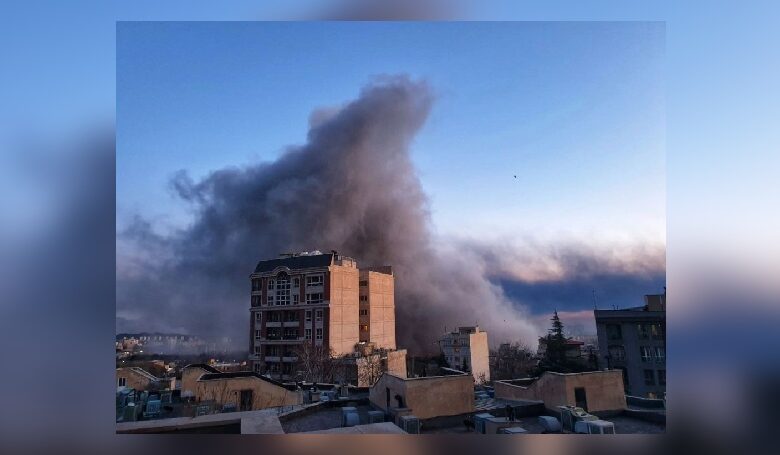
Successive explosions in Tehran and Karaj occurred as American and Israeli leaders spoke of intensifying military operations against the Islamic Republic in the coming week and destroying its military infrastructure.
Following the escalation of military clashes in the region, Iranian media reported on Friday, the 22nd of Esfand (March 13), the occurrence of several severe explosions in Tehran and Karaj. These explosions were reported hours after the Israeli army issued immediate evacuation warnings for some areas in central Tehran; an action that indicates the scope of war between the Islamic Republic and the US-Israel coalition has entered a new phase.
Reports indicate that the sounds of massive explosions were heard in various parts of Tehran, including the area around Enqelab Square, Ferdowsi Square, and Hijab Street. In addition, the city of Karaj also witnessed explosions, and local sources reported sightings of fighter jets flying at low altitudes over Tehran’s airspace.
Some reports also indicate that explosion sounds were heard in the north, northeast, southeast, and west of Tehran; a matter suggesting that potential attacks may have targeted several sensitive locations.
Coinciding with these developments, Donald Trump, the President of the United States, stated in an interview with Fox News that America is ready to deliver very heavy blows to the Islamic Republic in the coming week. He emphasized that if necessary, the United States will escort oil tankers through the Strait of Hormuz to prevent disruption of energy flow in the region.
Trump expressed hope in this conversation that US-led military operations in the region would be successful and meanwhile stated that the US military is in the process of “completely destroying” the Islamic Republic.
Referring to the status of Iran’s military forces, he said: “The naval and air capabilities of the Islamic Republic have been severely weakened and a large portion of this country’s military equipment has been destroyed.”
The American president also wrote in a message on the Truth Social network that the United States has “unparalleled firepower and unlimited ammunition” at its disposal and will be victorious in this war.
Trump continued this message with harsh language against the Iranian government, writing: “See what will happen to these crazy and despicable people today. They have been killing innocent people around the world for 47 years and now I, as the 47th President of the United States of America, am going to kill them. And what a great honor that is!”
He also emphasized that if someone follows reports from some media outlets, they might think America has not been successful in this war, but according to him, the reality is that the Islamic Republic’s military capability has been severely damaged.
Meanwhile, Scott Bessent, the US Treasury Secretary, stated in an interview with Sky News: “The war with the Islamic Republic has not imposed a heavy financial burden on Washington.”
He also dismissed the possibility that rising oil prices could make it difficult for America to finance the costs of war and stressed that the US economy has the ability to continue these operations.
On the other side of this crisis, Benjamin Netanyahu, the Prime Minister of Israel, in his first press conference since the start of the war with the Islamic Republic, delivered a direct message to the people of Iran.
He said that conditions for political changes in Iran are taking shape and the moment of beginning a new path of freedom is drawing closer every day. Netanyahu emphasized that since the start of the war, Israel has been eliminating all threats from Iran and military operations continue with the aim of destroying the Islamic Republic’s nuclear and missile programs.
He also stated that cooperation between the United States and Israel in these operations has been “unprecedented” and its achievements could alter the balance of power in the Middle East.
The Israeli Prime Minister further emphasized that military operations against the Islamic Republic and its allied forces in the region will continue and Israel is determined to complete the job.
He also warned that the Lebanese Hezbollah group will pay a heavy price for the attacks it has carried out in support of the Islamic Republic and, according to him, will increasingly feel the power of Israel’s arm.
Analysts say that recent attacks and reported explosions in Tehran and Karaj could be a sign of a new phase in this conflict; a phase that may transform not only the military structure of the Islamic Republic but also the political equations of the region.
While American and Israeli officials speak of a severe weakening of Iran’s military capability, many observers believe that the continuation of these conflicts could have profound consequences for the future of the Islamic Republic and Middle East stability.
With the expansion of the scope of attacks and the increase in military and economic pressures, the question becomes increasingly relevant: whether the Islamic Republic will be able to overcome this crisis or if the region is on the brink of a historical transformation.